Will the real Mary Maria Colling please stand up ?
(A Dartmoor Story about a lowly Tavistock resident in the Nineteenth Century)

Dolvin Road Cemetery - resting place of Mary Maria Colling (location of burial unknown)
Did Anna Eliza Bray edit Mary Colling's poems?
Recently I've been using AI more and more to aid me in my research around the many interesting stories to be uncovered about Dartmoor (both the famous ones, and the almost forgotten ones). Often it leads me down some very interesting rabbit holes, and sometimes some very dead ends 😁
As a side note, I would say that in my limited experience, AI is great at collating research, it is wonderful at cross referencing, keeping track of notes and ideas, but it still comes up short on occasion (and in fact several times, different iterations have outright lied to me).
Consequently, whatever it might tell me I will still (as much as I can) rigorously check sources and will always attempt to find corroborating evidence wherever I can.
It’s not going away, so as somebody who really enjoys learning new things, I’m embracing it’s usefulness.
Using it to replace truly creative pursuits I frown upon greatly.
Back to the question in hand.
Whilst reading some of the work of the famous Mrs Anna Eliza Bray, I came across (not for the first time) “Fables and Other Pieces in Verse”, published in 1831 by Mrs Bray.
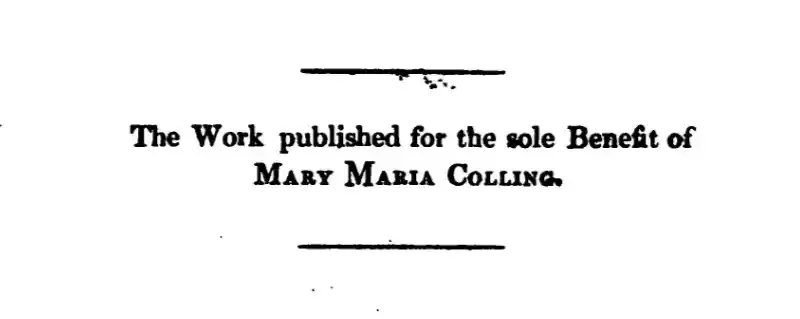
Interestingly (and one of the reasons for this article) on one of the opening pages the work is attributed to and "published for the sole Benefit of Mary Maria Colling."
When I searched back through the cobwebbed, dusty corners of my memory I vaguely remembered reading about Mary several years ago and making one of those many mental notes to look into her life when I had time. Like most of my brilliant plans, it’s sat on a shelf (gathering dust) for way longer than was good for it.
In my attempts to remain curious about Dartmoor (but not in a way that merely feeds the algorithms) I’ve decided to pursue things that interest me. Creativity is about being curious, not about writing the very same thing again in a slightly different way, so your SEO is better 🤣
I have to be honest before continuing with this analysis of Mary’s poetry.
Miss Dart (our English teacher who specialised in poetry) would be unimpressed.
I don’t really get on with poetry.
I’m sure if I was born in 1867 I’d be a much more fervent fan, however in this technological age, it’s not my “go to” art form.
Still, to ignore this interesting discovery would be (at least) amiss and it might give somebody who knows what they’re talking about a jumping off point for more research.
Like most adolescent boys who grew up in the late 70’s and early 80’s I tried my hand at writing poetry (I was a big Jim Morrison fan; and yes; my stuff was terrible).
Do young people still write poetry or are they all wannabe rappers now? A question for another time, I’m sure.
Here’s my favourite “proper” poem of all time: (so you might garner at least a little of my limited appreciation)
“I know monks masturbate at night, That pet cats screw, That some girls bite, And yet What can I do To set things right?”
Whilst pondering this question further; and having distractedly left the attic hatch of my memory open; I began to reminisce my ‘A’ Level English Literature lessons, that I had rather enjoyed Tennyson’s “Morte d'Arthur” and Pope’s “The Rape of The Lock” and (although my relationship with the bard is somewhat complicated) I do love me a bit of Shakespeare now and again.
One of the tenets I like to live my life by (and this investigation into a working class housekeeper from rural Devon fits nicely into that way of thinking) is that you should have no boundaries to what you consider interesting, what is thought of as worthy, what is “art”.
I love a good shouty punk song as much as I enjoy a beautifully crafted ballad. I’ll listen to Run The Jewels and then some Grieg. Human beings spend too much time cultivating reasons why their view of something is best, why
The attitudes of the Victorian critics to Mary’s work, whether supportive or scathing, is always indicative of the time and the whole “God given position”. We should judge on results. Results are subjective.
You and I can disagree, but we should always remain open minded.
… Then (out of the blue) The Millers Tale popped into my very odd head :
“This Nicholas was risen for to pisse,
And thoughte he wolde amenden al the jape;
He sholde kisse his ers er that he scape.
And up the wyndowe dide he hastily,
And out his ers he putteth pryvely
Over the buttok, to the haunche-bon;
And therwith spak this clerk, this Absolon,
’Spek, sweete bryd, I noot nat where thou art.’
This Nicholas anon leet fle a fart,
As greet as it had been a thonder-dent,
That with the strook he was almoost yblent;
And he was redy with his iren hoot,
And Nicholas amydde the ers he smoot,”
I absolutely loved that our English teacher, Mr Burrows, let us study The Millers Tale. Written by the 'father of English literature' it uses words like “pisse” and “fart” and “ers” (and even the Middle English equivalent to the “c” word).
The father of English Literature swore!
He wrote bawdy and funny stories.
He tells us more about the time he lived in than any history book ever could.
This is why I find Mary interesting.
So, Who was Mary Maria Colling?
Mary Maria Colling was born in Tavistock on 20 August 1804 (though it appears her date of birth is sometimes mis-quoted by Bray and others as 1805) and was baptised there on 2 September.
Her father, Edmund Colling, was a husbandman and assistant to the surveyor of the highways. Her mother, Anne (née Domville - the spelling is disputed), and there is some thought that this might be a derivation of an old French name.
At the age of ten, Mary was sent to a dame school to be taught needlework, and learned to read and write. At thirteen she taught her own father to read, as "it grieved her that his Bible could not speak to him."
At fourteen she entered domestic service as a lady's maid, eventually becoming housekeeper to Colonel Hughes and his wife. Her master gave her a strip of garden, which she liked so much that before long the whole garden ended up in her care and its beauty was widely commented upon.
Somewhere along the way she started writing poetry.
How Mary Colling came to be in print
By all later accounts she was something of a local curiosity in Tavistock once it was discovered that a "low-born" girl could produce unusually heartfelt verse.
“She had first attracted my notice in the church, where she usually sat with some of the poor women under the pulpit; I had been struck with the uncommon beauty and intelligence of her countenance; and a little servant of mine, who was herself acute and clever, told me that the young woman I so much admired, was a person of excellent character and poetical gift; that she lived as housekeeper and servant with an old gentleman of this place. This account raised my curiosity greatly, and I told my little maid that I should be glad to show Mary Colling any kindness in my power. This led to her sending pieces of poetry and to my becoming acquainted with her.”
The turning point comes in March 1831, when Mary posted a small parcel of her poems to the Vicarage and asked Mrs Anna Eliza Bray; the rather well known (at least locally) novelist and wife of the Vicar of Tavistock; to give her opinion on them. Bray's response was elaborate.
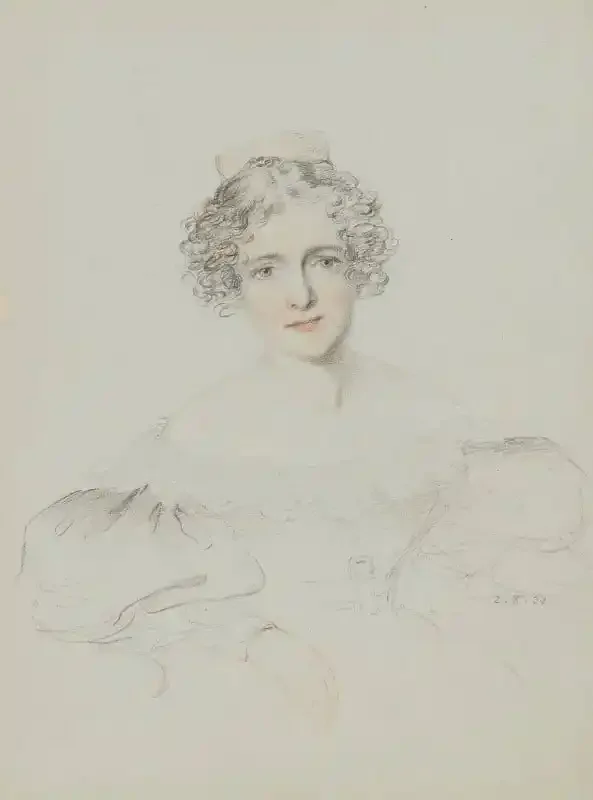
by William Brockedon black and red chalk, 1834
NPG 2515(71)
© National Portrait Gallery, London
She took down two of Mary's fables, sent them to Robert Southey (the then Poet Laureate), and arranged the publication of Fables and Other Pieces in Verse with Longman in 1831, by subscription. This meant that the patrons and their network effectively pre-paid for the book (more on this later).
The network Anna set up was substantial to say the least.
Mrs Bray travelled to London (to find a publisher) and, while there, was introduced to Letitia Elizabeth Landon ("L.E.L."), one of the most prominent literary women of the moment. Landon subscribed, and …
“the gifted L. E. L. honoured it with an ably-written review, which appeared in the ‘ Literary Gazette.’”
Personally, I believe this kind of “knowing the right people” is still an important part of the reason we don’t see greater variety in not only the arts, but also in business, industry, politics …
There’s a great deal of “marketing” going on here. There was already a history of promoting “uneducated poets”. We’re unused to seeing the over commodification of things by stuffy Victorians, however it’s merely a macro of what is happening with the monetisation of the internet.
“Her station in life and her few opportunities of developing her mind considered, she was altogether the most extraordinary person I ever met. Her mind was of masculine strength and her memory great; she possessed a natural eloquence, a pouring forth from the heart, with a ready, playful wit, somewhat inclining to the satirical. Those powers she improved, as opportunities for obtaining books enabled her to cultivate her mind, and she soon became familiar with the finest passages of Milton and Shakspere, for whose beauties she had the highest relish. Mr. Bray was as much struck with her genius as myself, so that, when at the beginning of the year Mr. William Patten was with us, we got him to make a drawing of her. He succeeded perfectly in the likeness, preserving all the delicacy of her regular and beautiful features, and rendering also that intellectual character which so strongly marked her countenance.”
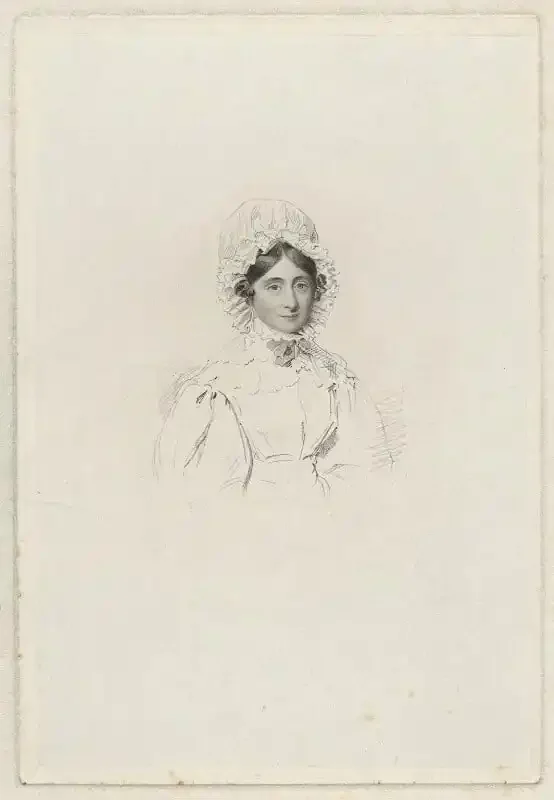
by Thomas Anthony Dean, after William Patten
stipple engraving, published 1831
NPG D34035
© National Portrait Gallery, London
Southey himself rounded up subscribers including William Wordsworth, Thomas Crofton Croker (best known for his Fairy Legends and Traditions of the South of Ireland), and Chauncy Hare Townshend (English poet, clergyman, mesmerist and collector - basically a posh rich bloke with some hobbies). Southey went on to write a very favourable review of his own in the Quarterly Review.
“Cultivation destroys wild flowers as civilization destroys wild animals. The greater number of those who are called uneducated poets in the present age, have actually received more education in their favourite art than those upon whom the utmost pains of regular culture were bestowed fifty years ago.”
I’m actively avoiding the whole “elitist” and “classist” way nearly all of these so-called “educated” people refer to Mary (it’s not irrelevant, but it isn’t directly a part of the argument I’m making here). Time changes attitudes, that doesn’t mean we should ignore them - I’ll address and expand these in later articles (perhaps).
Dennis Low in his book The Literary Protégées of the Lake Poets, has written possibly the most useful modern account of the publication, characterising the combined efforts of Mary’s patrons, thus :
“Considering that Colling was an unknown and uneducated maid-servant from Devonshire, the combined influence of Southey, Bray, Landon and Jerdan was a particularly fine example of the ‘puffery’ that was commonplace amongst the 1820s’ literati.”
(Jerdan was the editor of The Literary Gazette and I’ve been unable to ascertain if it was him or Letitia Elizabeth Landon [as Mrs Bray suggests] that wrote the review).
Not everyone in Bray's own circle was convinced. Her nephew John Kempe (who eventually edited her autobiography after she died), wrote from Clare College Cambridge in March 1832 (quoted in Dennis Low’s 2006 book) …
“And now, Aunt, I am going to confess a heavy conviction forced upon me by the sifting which Mary Colling has undergone among my Cambridge friends - it is this, that she is not worthy of the Quarterly (not that I think now she will get in) nor likely to obtain any reputation beyond the circle of the ‘splendid dish’. To me & to those who know her & all about her the book is very interesting, but put it into the hand of an unprejudiced observer & he is sure to call it ‘humbug’.”
That was the verdict of Bray's own family.
The book itself is roughly half Mary's poems and roughly half Bray's letters to Southey about Mary. Three of those letters open the volume, detailing Mary's "familial background and unblemished character."
The patron basically qualifying the moral acceptability of the working-class poet, in writing, at the beginning of her own book.
The question that emerged about M. Colling’s Poetry
Reading around the subject of Mary, I came across more than one writer who'd questioned the “validity” of Mary’s work as well as whether or not the poems in Fables were really hers. Did the Brays "help" with the construction?
The fullest modern reading of the volume is Erica Obey's 2010 essay in the Keats-Shelley Journal, “‘The Poor Girl's Talent’: Romantic Mentorship and Mary Colling's Fables”.
Obey reads Fables not as condescending patronage but as something much more clever and way more sympathetic, a covert critique of the masculine myth of Romantic genius scribbling away in splendid isolation.
She has assembled out of the very multi-voicedness, the heteroglossia, that a patronised labouring-class volume creates by its nature, with Southey, Wordsworth, Bray and Colling all talking through and past one another on the page.
It is a persuasive reading on its own terms; but the intelligence it credits is Anna Bray's.
In Obey's account the editorial mediation is not a problem to be cleared away but the method itself, and Mary's self-effacement, the fables stripped of their morals, the meaning handed to a rose or an owl to speak, becomes a deliberate, even radical, gesture of Mary's own.
My investigation runs underneath that argument rather than against it. Obey worked from the same Bray papers and independently dates one of the notebook poems to 1820, the West Sussex Record Office brackets the book at 1820–25, several years before Bray "found" her, but she reads it for what it tells us about Bray's arrangement, not for what it preserves of Mary's text.
Setting that manuscript line by line against the printed page, I find that a good deal of the self-effacement Obey reads as Mary's choice was in fact the editor's hand: stanzas cut and added, theology softened, and in at least one instance a correction Mary made to her own verse simply overruled.
The poem Obey treats as the wellspring of Mary's authentic voice, "The Storm," is among the most heavily reworked of all.
None of this refutes her; it answers the narrower, more literal question she sets aside - how much of the book is actually Mary's?
“Bray’s conservatism registers in her preface’s application of the term “genius” to her patron, not to her protégée. She praises Southey’s “generous feeling toward the luckless children of the muses” as well as his “transcendent genius”. Bray characterizes Colling as merely “clever” and “talented” - qualities that are apparently on a par with the poet’s “good practical sense” in housekeeping. Bray emphasizes Colling’s prodigious memory, a trait that aligns her with the superior imitative capability attributed to native geniuses and diametrically opposed to the originality imputed to Romantic, masculinized genius. ”
Low's work (his 2003 thesis and 2006 book on Southey's female protégées) gives a nod to the Bray/Colling case, however by his own admission on page six of his rather splendid book, he leaves Bray herself as "one glaringly obvious omission".
In short, there is no comprehensive account of Anna Eliza Bray's editorial relationship to Mary Colling.
I’d be the first to admit I’m no academic and I’m hardly in a position to claim any authority in this area, I’m just somebody with an inquisitive mind. Curiosity might have killed the cat, but it also made the cat a way more interesting companion.
If I’m completely honest, the thing that drove this whole deep dive into a long forgotten nobody from Tavistock, it was the very tiny thought that Large Language Models thrive on analysing text, and here we had some text worthy of analysing.
So I set about asking Claude to “read” what was available online of Mary's published verse and Bray's published prose, look for stylistic patterns, and then (more usefully as it turned out) to help me work through a few examples of Mary’s manuscripts themselves I found by searching the West Sussex Record Office.
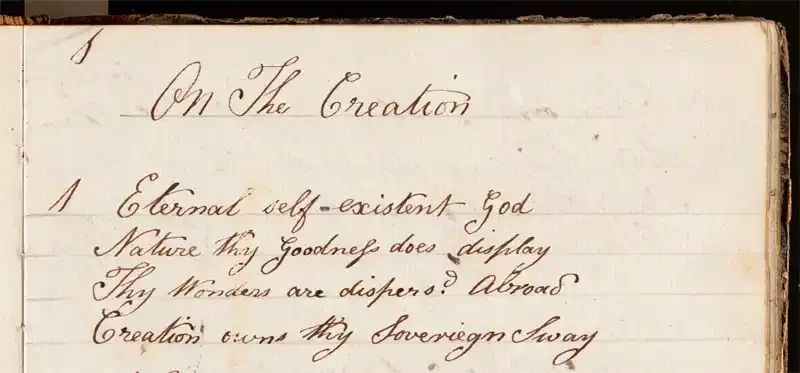
Reproduced with permission of West Sussex Record Office. Catalogue No: Bray 2/1
Hand written poetry book by Mary Maria Colling
I had absolutely no expectations and no preference as to what the results might yield. Driven purely by curiosity I was happy to realise that I might have found a useful task for AI.
The short answer from Claude is … yes, Mary wrote the poems.
However, (and this is where my rabbit hole was dug way deeper and exponentially wider) it would appear that the published versions in “Fables and Other Pieces in Verse” are measurably edited reworkings of what Mary actually wrote in her hand written notebooks.
I should possibly restate now that I am neither an expert in linguistics or poetry, nor am I even a particularly good writer, I didn’t do the difficult legwork for this research, the AI did and I’m happy to be told it’s workings are dubious; or even wrong; whatever the reason, the published works are substantially different from Mary’s handwritten work.
Substantial enough to materially alter her voice, the structure, and in some places the theology of the words (it can be easily established that Mary was rather religious).
I can see for myself that the hand written poems I asked to be sent from the West Sussex Record Office Home are different from those published in 1831.
It would be pointless to discount that Mary herself may have reworked her words (possibly numerous times over many years) I’m just proposing a hypothesis and remaining curious.
Let us first look at the idea that Mary and her poetry were (for want of a better phrase “well packaged”.
Mary was literate, and demonstrably wrote things down.
“I mentioned, I believe, in a former letter, that she had not been in the habit of writing down her compositions, and that when I asked her how she managed to preserve them, she gave me a truly Devonian reply, assuring me that ‘ she could mind them,’ meaning she could retain them in her memory.”
I think this is a very important fact, and it cuts through a great deal of the romance and the clever marketing. Mary could read and write (her spelling might not have been spot on) but she wrote her poems down in a notebook signed in her own hand and dated 1825. It’s held at the West Sussex Record Office.
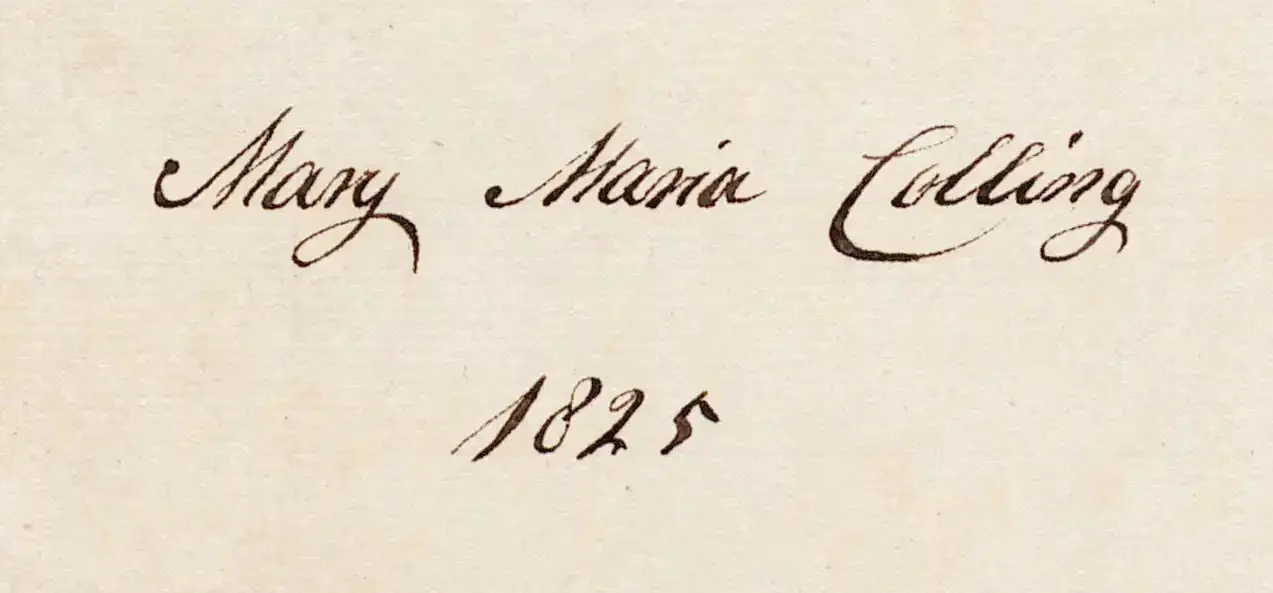
Reproduced with permission of West Sussex Record Office. Catalogue No: Bray 2/1
Hand written poetry book by Mary Maria Colling
The date matters here.
It places this notebook several years before Bray's "discovery" of Mary in 1831, the West Sussex Record Office brackets it at 1820-25.
The poems in it; including "On the Creation," the poem the standard account says was inspired by Edward Atkyns Bray's sermon and was supposedly Mary’s first attempt at poetry is written out in Mary's own handwriting, long before any documented editorial relationship existed.
“.. and as to her language, she had gained that from hearing Mr. Bray preach. To listen to him was her greatest delight, and she thought she owed much to his sermons. As a proof of it,” she said, “ he had inspired her to attempt poetry.” It was on the following occasion, about six years ago, he preached a sermon on the power of God manifested in the creation of the world ; she was struck with it, and, on her return home, composed the following, being her first essay in verse ...”
A girl who teaches her own father to read at thirteen, and who keeps a dated notebook of her own poems at twenty, is definitely not composing in the manner of an illiterate folk bard.
The "she didn't write them down" framing is older than Mary.
The “simple working class country girl”, composed-in-her-head story, which I believe is partly responsible for some of the critical backlash which Mary endured, comes directly from Bray's letters to Southey.
It’s then merely recycled in the “Spectator's” puff piece of January 1832:
“Mary Colling is a spirited and a pretty girl, whose reputation even the envy she so lashes has not touched; and, like Mr. Jones the butler, Mary the housemaid has never yet permitted her devotion to the Muse to interfere with the duties of making beds and scouring floors. With, however, a most laudable consideration of her tastes, and as an appropriate compliment to her powers, her master has put the flower-garden under her care; and here, and in her old kitchen-chair, she chiefly composes her verses,—not committing them to paper, but “minding” them, as she calls it, in the manner in which it may be remembered of Mr. Jones, who, when the bell rang, used to imprint his unfinished stanzas on his memory, by repeating his verses to the music of the stairs.”
The "she didn't commit them to paper" line is, in the end, a clever packaging device.
It fits into a very established Victorian literary market: the brilliant “natural genius” from the working classes, untutored, uneducated, composing by inspiration.
Stephen Duck (the “threshing” poet, taken up by Queen Caroline in the 1730s); John Clare, whose publisher John Taylor apparently heavily edited him; Mary Collier, the Petersfield washerwoman who answered Duck in 1739; John Jones the Butler.
All of them came with similar framing. Composing-in-the-head had become a trope of the genre, not a Colling speciality. It’s almost unthinkable that so called “real poets” wrote absolutely everything down.
It’s also very likely the writer in The Spectator knew this perfectly well. They note, with a fairly dry sideways glance, that Southey seems to be considered “the general father of the illegitimate muse”.
They’re not taking the “natural genius” packaging entirely at its face value.
I’m at pains here to point out that just because something isn’t true, doesn’t mean that automatically negates any value it might hold (this is a very important distinction I hope to investigate in future articles).
Southey's verdict, and what it licensed (The Poet Laureate and The Romantic Novelist)
In the letters between Bray and Southey:
“To use your own words, she has “the eye and the ear, and the feeling of a poet” though in her — more than in Mr. Jones — “the art may be wanting;” but with her, in the bloom of youth and health, it is not too late to acquire it.””
It’s worth paying particular attention to that sentence. It’s the patronage of “lowly poets” perfectly distilled. Mary has raw talent but the “art” is wanting.
Which means, conveniently, that the patron “class” can supply what's missing. The Poet Laureate of England, the most authoritative literary voice of his moment, has diagnosed a deficiency that justifies the intervention. The patron diagnoses the gap. The patron then fills it.
While researching this I discovered a less than pleasant review of Mary’s work in the Monthly Review from 1st December 1831 which very pointedly makes note that Southey had not (at this juncture) made any comment on Mary’s work:
“There is no disputing about tastes: we suppose that Mrs. Bray knows her man, and was probably courting Southey for an article upon her novels in the Quarterly; otherwise common delicacy must have prevented her from penning such trash. ”
A year later, when Southey came to write his own Quarterly Review article on the volume, he was open about who had filled it. He refers, more than once, to Anna Eliza Bray as "the benevolent editor of this volume." The word he uses is “editor”.
Not patron, not friend, not introducer. Editor.
Even in The Spectator article:
“The lady who has undertaken to edite (sic) Mary’s fables is Mrs. Bray (formerly Mrs.
Stothard), the authoress of some novels of repute.”
Southey, The Poet Laureate of England, in the principal Tory literary periodical of the day, acknowledged in print that Bray was Mary's editor, even as the volume's title page kept the relationship deliberately ambiguous.
What Southey was actually responding to when he wrote his initial assessment to Bray we don't know exactly. He probably didn't see the manuscripts in front of me. He had seen what Bray had shown him.
That's important, because what Bray was preparing to print is, as it turns out, substantially different from what Mary had written in her leather bound books.
“Mr. Southey spoke warmly in praise of Mary Colling; and observed that in the eyes, forehead, and upper part of the face she was perfectly beautiful. ‘ What a sweet creature she would have made,’ said he, ‘had she but been brought up in a little higher sphere of life.’”
Going back to Mary Colling’s Handwritten Manuscripts
As I mentioned previously, after an inordinate amount of digging around, served up with a very large side portion of Internet Trawling, I have in my possession scans of two poems in Mary's own hand: "The Storm" and "On the Creation." (Thanks to the lovely archivist at West Sussex Record Office)
Both can be set alongside the printed text of Fables and Other Pieces in Verse (1831), and against the Spectator's January 1832 reprint of "The Storm."
The book and the Spectator have basically the same text, the same stanzas, the same wording. Logic tells us that the editorial work was done at the book stage, by whoever edited it for the publishers, Longman.
That whoever is, by every available indication, probably the Brays. The result of the comparison is a more substantial reworking than the standard account allows.
"The Storm"
Mary's manuscript "Storm" has fourteen stanzas.
The published version has eleven.
Four of Mary's stanzas were cut, one new stanza was added that doesn't appear in the manuscript at all, two stanzas were swapped in order, and individual lines throughout were significantly rewritten.
Here’s a side by side (unless you are on a phone, where one is below the other) comparison of the manuscript and printed versions, before we analyse the differences. I’ve left in Mary’s spelling mistakes and not (at this point) added in her corrections or hand written edits.
Manuscript
Behold the sky is over cast
with A Terriffic Gloom
The Raging storm increaseth fast
And Threats Impending doom

The Atmospheres in Tumults Hurl'd
And From the Frowning North
The Storm upon the watery World
In Fury Marches forth

Behold the Shivering Vessel Rocks
Upon th' Ambitious wave
The Seamans Art and Skill it Mocks
And threats A Watery Grave

Still Still with Unrestrained force
The Raging Billow lifts
Its Waves and over flows its Course
And Sweeps the Lofty Cliffs

Stanza Added ←
Stanza Added ←
Stanza Added ←
Stanza Added ←

The Lightening Darts with Awfull Glare
Fast Flie(s) the Vivid Flakes
The Thunder Roars and Rends the Air
The Vault of Heaven it shakes

While Toss'd upon that deep Abyss
The Hapless Seamen Give
The Mournfull Signal of distress
But None Can them Relieve

No Tracks of Safety can they Trace
How dreadfull is the Gloom
And Each with Horror in his face
Anticipates his Doom

They Cannot there for Shelter hide
Nor Shun the Ruthless foe
Danger looks big on every Side
And fears Increase the Woe

Now Each his fruitless Art doth drop
Nor doth the Storm impair
They take farewell of Every Hope
And plunge in deep despair

O Righteous Heaven in Mercy Deign
Their hapless State to view
Thou Canst the Raging winds Restrain
And Calm the Ocean too

Now in this Most Distressing time
They Earthly help have None
Bereft of Every help(aid) but Thine
Of Thine O Lord Alone

Danger Her direfull Yell Repeats
Thy pity Now they Crave
O Let them know the power that [threats]
Is Still as strong to save

Let them be Led to see that thou
O'er all things bears Command
That with Submission they May bow
Beneath thy Mighty Hand

Thou Givest the Stormy winds decree
Thy judgments to fulfill
These Heralds of thy Majesty
Obey thy Sovereign Will
Published (1831)
Behold, the sky is overcast,
With a terrific gloom ;
The doleful night is hastening fast,
And brings impending doom.

The atmosphere's in tumults hurl'd.
And from the frowning north,
The storm upon the watery world.
In fury marches forth.

The bosom of the mighty deep.
Is swell'd, and day departs ;
As bursting from a silent sleep.
Gigantic horror starts.

Its darkening waves with fearful force,
The angry ocean lifts ;
The billows overflow their course,
And sweep the lofty clifts

On high the shivering vessel rocks,
Upon the ambitious wave ;
The seaman's art and skill it mocks,
And threats a watery grave.

The lightenings dart : with awful glare
Fast fly the vivid flakes ;
The thunder rends the boundless air,
And Heaven's high vault it shakes.

While toss'd upon the deep abyss,
The hapless seamen give
The mournful signal of distress.
But none can them relieve.

Stanza Removed →
Stanza Removed →
Stanza Removed →
Stanza Removed →

They can no where for shelter hide,
To shun the ruthless foe ;
Danger looks big on every side.
They fear increase of woe.

Stanza Removed →
Stanza Removed →
Stanza Removed →
Stanza Removed →

All gracious Heaven, in mercy deign,
Their hapless state to view !
Thou can'st the raging winds restrain,
And calm the ocean too.

Stanza Removed →
Stanza Removed →
Stanza Removed →
Stanza Removed →

Danger her direful yell repeats,
Thy pity now they crave :
Oh ! let them know the power that threats
Is still as strong to save.

Stanza Removed →
Stanza Removed →
Stanza Removed →
Stanza Removed →

To stormy winds, thou giv'st decree,
Thy judgments to fulfil :
As heralds of thy majesty,
They all obey thy will.
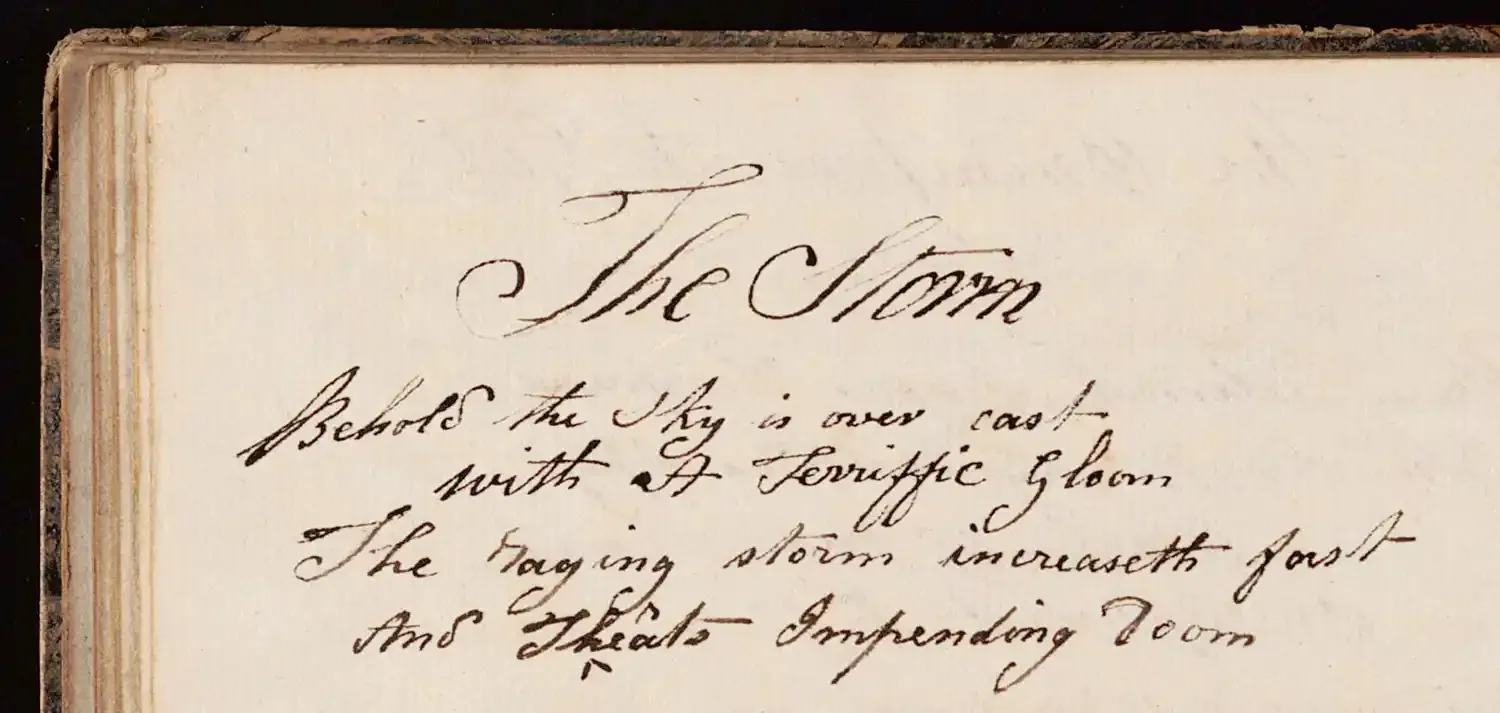
Reproduced with permission of West Sussex Record Office. Catalogue No: Bray 2/1
Hand written poetry book by Mary Maria Colling
A handful of examples will give the flavour.
Mary's opening stanza:
“Behold the sky is over cast with
A Terriffic Gloom
The Raging storm increaseth fast
And Threats Impending doom.”
And in the printed book:
“Behold, the sky is overcast,
With a terrific gloom;
The doleful night is hastening fast,
And brings impending doom. ”
The first two lines come through.
Lines three and four are completely rewritten.
Mary's raging storm becomes the editor's doleful night.
The image is no longer of a storm intensifying but of darkness approaching ,a very different picture altogether.
Later in the poem, a single word goes from plain to archaic.
Mary's manuscript:
Its Waves and over flows its Course And Sweeps the Lofty Cliffs
Published:
The billows overflow their course, And sweep the lofty clifts.
“Clifts” with a “t” - this is a venerable old poetic word, used by Spenser, Milton, and the King James Bible (as in "the clift of the rock").
The editor reached back into Renaissance and Augustan diction to make Mary's plain cliffs sound more literary. They didn't tidy her plain English; they replaced it with antique English.
Before I push the "they archaised her" line too hard, I have to be fair to the evidence, because it cuts both ways.
Mary's manuscript is not plain, modern, vernacular English.
It is already reaching for a literary register. In "The Storm" alone she writes "the Raging storm increaseth fast," with the old -eth ending; she shortens the into "th' Ambitious wave" the way eighteenth-century poets did to keep a line scanning; she inverts her syntax for effect.
"The Storm upon the watery World / In Fury Marches forth."
In "On the Creation" she reaches again and again for the archaic second person:
"Thou speak'st the Word," "Thou mad'st the Earth," "Thou Brought'st in Man." These are Mary's own words, in Mary's own hand, six years before any Bray took a pencil to them.
So the picture isn't the tidy one of a plain-spoken country girl whose honest vernacular was gentrified by her betters. Mary “wanted” to sound more like she believed a poet should, and the poets she had to hand, the ones she'd have heard from the Vicarage pulpit and met in whatever books reached her, were the poets of the previous century.
The olde worlde writing was, in part, hers.
What the editors did was not invent that register but finish it. Where Mary wrote does, they wrote doth.
Where she wrote cliffs, they wrote clifts.
Where she reached for an eighteenth-century effect and didn't quite land it, they landed it for her.
Mary writes the archaic "increaseth" in her manuscript, and the editors cut that whole line in the printed text (your opening stanza becomes "The doleful night is hastening fast"). So one of Mary's genuine archaisms was discarded while new archaism (does → doth, cliffs → clifts) was imported elsewhere, which tells me the “editors” weren't preserving Mary's old-fashioned flavour, they were substituting their own.
Which, awkwardly, lands us right back on Alford: "Her language is not that of her own home, but of her friendly patrons." He meant the printed verse.
But the manuscript suggests it was true even of the words Mary wrote herself, she had absorbed the patrons' register before they edited a single line. The voice was being borrowed at both ends. And that makes the authorship question more tangled, not less: even where the hand is unmistakably Mary's, the ear behind it may already have been the Brays'.
The theological alterations are subtler but, I think, more telling.
Mary's stanza begins:
O Righteous Heaven in Mercy Deign
In print this becomes:
All gracious Heaven, in mercy deign
Mary's God in "The Storm" is “righteous”, judging, sovereign, awesome. The editor's God is “gracious”, merciful, kindly, consoling.
That's not a smoothing change. That's the kind of revision someone makes when they have a definite view about what English religious verse ought to sound like in 1831. And then, three stanzas later, the closing couplet:
These Heralds of thy Majesty
Obey thy Sovereign Will
becomes:
As heralds of thy majesty,
They all obey thy will.
“Sovereign”; possibly the strongest word in Mary's couplet; describing the divine authority her shipwreck poem is finally addressing, is gone. Mary's basic narrative survives. Her core imagery survives. But the published "Storm" is, in many ways, a more conventionally devotional, theologically gentler, and stylistically older sounding (Romantic) poem than the one she actually wrote.
"On The Creation" - Mary Maria Colling in her own hand
If "The Storm" is suggestive, "On the Creation" is direct. Mary's manuscript version, dated 1825, has five stanzas.
The published 1831 version has seven.
Two stanzas were added, the manuscript shows no sign of.
One of those added stanzas opens:
“The spacious firmament was rear’d,
— Soon as the dread command was given;
Unnumber’d worlds at once appear’d.
And gemm’d the azure arch of heaven. ”
Obey observes that the first line is almost certainly an echo of Joseph Addison's hymn "The Spacious Firmament on High" (1712), one of the most famous English religious poems of the period.
Bray, in her preface, attributes Mary's knowledge of the phrase to Mary hearing it quoted by Edward Atkyns Bray.
Obey though, clearly states :
“One has to be careful, however, about attributing Colling’s diction to such adventitious circumstances as personal acquaintance with the Brays. As Coleridge observes in chapter 17 of the Biographia , regular exposure to the Bible and the Anglican liturgy improves the diction even of the working class. Left to her own devices, Colling might well have gone on to write even more poems like the “Hymn on the Nativity” and “From Isaiah,” appended to the Fables volume.”
Obey even acknowledges that “Anna Bray's papers contain Colling's original copy book of poems.” though doesn’t seem to consider that maybe Colling wasn’t the author of those lines at all.
Manuscript
Eternal self-existent God
Nature thy Goodness does display
Thy Wonders are dispers'd Abroad
Creation owns thy Sovereign Sway

These Products of Creating Skill
To Speak thy Praise they all combine
They are Subservient to thy will
And all proclaim thine Hand Divine

Stanza Added ←
Stanza Added ←
Stanza Added ←
Stanza Added ←

Thou speak'st the Word and they obey'd
If Angels did with Praise employ
Ten Thousand Forms at once were made
The Morning Stars they Sang for Joy

These Wonders of thy mighty Hand
Show us thy Wisdom is immense
And There display'd thro' every land
Memorials of Omnipotence

Stanza Added ←
Stanza Added ←
Stanza Added ←
Stanza Added ←

Thou mad'st the Earth with Charms [Replete]
And Blessings fill'd this lovely Frame
And When thy System was Complete
Thou Brought'st in Man to praise thy Name
Published (1831)
Eternal, self-existent God!
Nature thy goodness doth display;
Thy wonders are dispersed abroad;
Creation owns thy sovereign sway.

These products of creating skill.
To speak thy glorious praise combine;
They are subservient to thy will,
And all proclaim thine hand divine.

The spacious firmament was rear'd,—
Soon as the dread command was given;
Unnumbered worlds at once appear'd.
And gemm'd the azure arch of heaven.

Nature thy sovereign voice obeyed;
Angelic songs it did employ;
Ten thousand forms at once were made;
The morning stars they sang for joy.

The wonders of thy mighty hand
Show us thy wisdom is immense;
For there 's display'd through every land
Memorials of Omnipotence.

From heaven, thine own eternal seat,
Thine eye surveyed this lovely frame,
And when the system was complete,
Man was brought in to praise thy name.

The new-born day rose at thy word;
'Twas usher'd in with seraphs' lays;
They tuned their harps, and forth was pour'd
A universal tide of praise.
The entire stanza containing the phrase isn't in Mary's 1825 manuscript at all. Possibly Mary added it to a later draft, or possibly the stanza was supplied editorially and the attribution to Mary's "hearing the phrase" is part of the extended fallacy of the “uneducated poet”.
“Azure arch of heaven, gemm'd” seems to me, to belong to the Addison hymn tradition, not to a labourer's daughter in Tavistock. If anything they are in the tradition of the Vicarage.
Within the stanzas Mary did write (we can see them in her own hand), the same kind of intervention recurs.
Her line "Thou speak'st the Word and they obey'd" is a plain biblical echo of Genesis and the Gospel of John — becomes the editor's "Nature thy sovereign voice obeyed."
The Word is gone; in its place an abstracted Voice. The biblical resonance has been quietly turned down. And then there is the single piece of evidence that, on its own, settles the question of what the editorial relationship actually was in practice.
In stanza five of Mary's manuscript, she has written: Thou mad'st the Earth with Charms And Blessings fill'd this lovely Frame And When thy System was Complete Thou Brought'st in Man to praise thy Name
As written, the rhyme doesn't work (at least to my mind) - Charms and Complete don't rhyme.
Mary noticed. She wrote the word “Replete” in the upper margin of the page, indicating the correction: the line should read "Thou mad'st the Earth with Charms Replete."
That gives a clean ABAB rhyme: Replete / Frame / Complete / Name.
It is Mary's correction to her own poem, in her own hand, on her own manuscript.
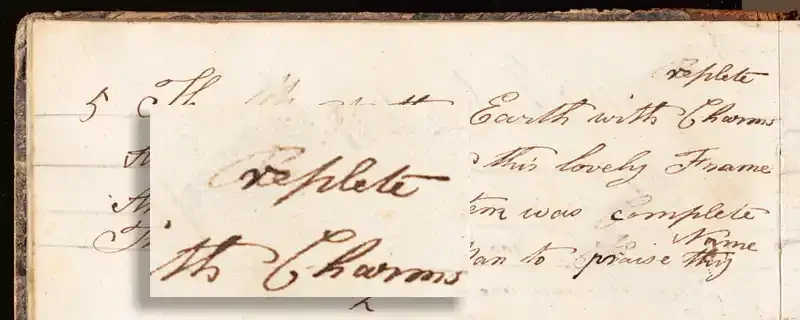
Reproduced with permission of West Sussex Record Office. Catalogue No: Bray 2/1
Hand written poetry book by Mary Maria Colling
The published version did not use her correction. Instead, the editor rewrote the first two lines entirely:
From heaven, thine own eternal seat,
Thine eye survey'd this lovely frame,
Mary's image of God making the earth with charms, blessings filling its frame, is replaced with God's eye surveying creation from his eternal seat in heaven. Conventional. Devotional. Eighteenth-century-hymn. Whoever edited this saw Mary's correction in the margin of her own manuscript, and overruled it. That, I think, is the patron-mediation relationship caught in the act on a single page.
Which Bray held the pen?
There's a quiet assumption running through almost every account of Mary’s work, including my own, until now. It kind of goes without saying that when we say "Bray" edited Mary's poems, we mean Anna Eliza Bray.
What if she didn’t?
Anna Eliza Bray was a novelist. A very prolific and pretty successful one but a writer of prose. As far as I can see, in a career spanning sixty odd years she never published a single poem of her own.
The one book of verse her name is attached to is “Poetical Remains” (1859), and that is her late husband's poetry, selected and edited by her after his death. Anna's whole relationship to poetry was editorial. She arranged other people's verse; she didn't write it.
Her husband did.
Rev. Edward Atkyns Bray (1778–1857), Vicar of Tavistock and perpetual curate of Brent Tor, had been writing poetry since boyhood, he circulated two small collections of his verse amongst his friends before he was twenty-three. He was schooled almost entirely at home, came to the Church by way of the bar, and belonged, very much by birth and habit, to the eighteenth century.
His poetic models were the models of the previous age. When Alford's witnesses spoke of "Mr. and Mrs. Bray" correcting and polishing Mary's verse, they named him first, and I don't think that's an accident.
“Others tell me it was a general impression that Mr. and Mrs. Bray corrected and gave a finishing polish to M. M. Colling’s published verses.”
Because every editorial fingerprint in "The Storm" and "On the Creation" points the same way.
“Cliffs” reaches back to “clifts”; plain biblical English is lifted into Augustan hymn diction; a whole stanza arrives echoing Addison's "The Spacious Firmament on High" (1712).
That is not the instinct of a Regency novelist. It is the instinct of an eighteenth-century clergyman-poet, a man who'd have known the Addison hymn off by heart, and for whom "the azure arch of heaven, gemm'd" was not an affectation but his first language.
A smoking gun?
The standard account says "On the Creation" was inspired by a sermon of Edward Atkyns Bray's, on "the power of God manifested in the creation of the world."
So the one poem we can watch being expanded with borrowed hymn-diction is the very poem the vicar himself set going. The sermon was his. The theology of the additions is his. The eighteenth-century diction is his.
Obviously I can't prove Edward held the pen, it’s all speculation and short of a marginal note in his hand surfacing somewhere, it will only ever remain speculation.
But "the editor" has all this time been quietly assumed to be the famous Mrs Bray, when the evidence, the diction, the theology, the sermon, the order in which Alford's witnesses named the names, points at least as firmly at the less famous Mr Bray beside her.
At the least it was a joint operation. At most, the woman whose name carries the story did the discovering, the letter-writing and the marketing, while her husband did the versifying.
A small correction, but the kind that matters: maybe we've been crediting the wrong Bray?
What was actually happening between Southey, The Brays, Mary Colling ?
None of this softens the two hardest pieces of evidence, though. A whole stanza of Addison-flavoured hymn diction that appears nowhere in the manuscript is an addition, not an amplification, I feel like you can't absorb your way into a stanza you never wrote.
And Mary's own corrected rhyme, overruled in favour of the editor's line, is a plain overruling whatever register she was writing in.
If you take the two manuscript poems together, one cut and rewritten, the other expanded and rewritten, what emerges is not a "finishing polish" (the phrase used by Rev. D. P. Alford, a later Vicar of Tavistock who saw a different set of Mary's manuscripts in the 1890s and concluded the published verse essentially matched).
What emerges is something larger and more interesting: a consistent editorial process that took Mary's raw text and remade it to fit the literary register of her patrons.
Alford's observation holds up perfectly against the manuscript evidence: Her language is not that of her own home, but of her friendly patrons.
Anna Bray herself says:
“Not long after the successful appearance of Mary Colling’s book, I began to taste the sweets, or rather the bitters, of patronizing and editing uneducated poets, for applications were made, and MSS forwarded to me, from a variety of quarters; all hopeful authors requested the same favour that had been bestowed on her. It was annoying in the extreme.”
Note the use of the word “edit”.
Anna is already regretting the choices she has made.
Obey's reading of Fables as a heteroglossic feminist text is largely compatible with what the manuscripts show, and where she goes way beyond what I've done here; for instance, in her sharp reading of the frontispiece portrait, where the housemaid's bonnet overpowers Mary's face, or in her account of how the Mary Philp grandmother narrative deviates from the standard "annals of the poor" Southey had asked for.
But on the specific question of how much Mary's voice survived intact into print, the manuscripts tell a more pointed story than the published volume alone can. The "heteroglossia" in which Mary supposedly participated turns out, at the level of individual stanzas, to be more often Bray's voice than Mary's. The Replete moment in particular is the kind of evidence Obey's framework can't fully accommodate. Colling is making her correction; the editor is overruling it; the relationship is one-directional in this specific instance, whatever it may have been in the abstract.
Who is to say Mrs Bray suggested edits and Mary’s position merely made it easier to agree.
The critics in the room - Mary Maria Colling analysed
The patronage circle was not blind to what they were doing, and they were not the only ones watching. Read across the five major periodical reviews of Fables from 1831 and 1832, the same concern surfaces in different voices, from different political and aesthetic positions, and with very different degrees of sympathy for Mary herself.
The Athenaeum in 1831 (the review almost certainly by the Lake Poet protégée Maria Jane Jewsbury) admired the volume but warned that bringing Mary "forward as a poet, drawing public attention to her as an intellectual marvel, another of the race of prodigies, is not too perilous a price for a temporary benefit." Already, the reviewer noted, Mary "appears to have suffered from the envy and ill-will of her equals in life, but inferiors in mind." The writer offers the sharpest single diagnosis of Mary's situation in 1831:
“She occupies an anomalous position: sufficiently gifted to be above her born associates, and not sufficiently so to break down, or have broken down for her, the factitious barriers that lie between herself and those above her, she is placed in a position similar to that of a person looking up at the stars.”
The Gentleman's Magazine in December 1831 framed the volume as a courtroom case in which Mary was "arraigned at the bar charged with trespassing on Parnassus" and acquitted only after Mrs Bray testified on her behalf.
Even the favourable verdict reads Mary's writing as inherent trespass. The reviewer's own warning was theological rather than social: if the literary attention should "lead her from the path of duty, she will have eaten of the tree of knowledge but to the increase of her own responsibility."
The Fall narrative, applied to working-class education.
The Spectator in January 1832 was knowingly arch about the whole patronage tradition, sliding in its sideways remark about Southey as "the general father of the illegitimate muse."
And Southey himself, in the Quarterly Review of 1832, opened his twenty-three-page article on Mary by explicitly pairing her with Lucretia Davidson (an American girl-poet who had died young after being overstimulated by literary attention) and who Southey himself had eulogised in his own 1829 essay as a cautionary tale.
Six months earlier, in a private letter to Bray dated 14 July 1831, Southey had warned that Mary's "nervous disposition" required careful handling, citing exactly this Davidson parallel: "That sweet American girl Lucretia Davidson was beyond all doubt killed by excitement of this kind."
Then he goes ahead and writes a twenty-three page puff piece that basically puts Mary in the same frame.
The warning was in the room. He printed the warning. And he proceeds with the marketing plan anyway.
Sharpest of all was the Monthly Review in December 1831, whose anonymous reviewer was openly hostile to Mary, to Bray, and to the whole genre of patron-mediated working-class verse.
The contempt for Mary herself is undisguised ; her fables are "trash," her satirical pieces evidence of "natural malignity and bad temper," her best fate would be to "sell fruits and flowers from her own garden" rather than write.
The class snobbery is unmistakable. But underneath the snobbery, this reviewer named the structural mechanism more clearly than any of the others.
The article opens with a thought experiment: that they could, if they chose, take up the hymns of "a very worthy man"; a gardener of their acquaintance; "polish them up" for the religious public, collect subscriptions, obtain "a most grateful dedication," gather "various particulars of his life," and "gain a little fame for ourselves, but very little money for the poor man; and end in giving him so much disgust for his present honest and industrious mode of living, as to render it necessary for him, in a short time, to solicit... the assistance of his parish."
That is the patronage operation laid bare, in print, in 1831 along with a prediction of the harm done to Mary.
The reviewer goes on to identify "the vanity of the patron, or the patroness" as the engine of the whole genre, and to call Bray, like Southey before her, the editor of the volume — "the poetry is worthy of both parties, the inditer and the editor."
And the review closes by saying Bray "alone must stand accountable to this poor girl, for the disappointment of hopes that ought never to have been encouraged, and most probably for rendering her discontented with the humble station in life, in which it was the will of Providence to place her." A hostile critic, in print, in 1831; and, as we'll see; fourteen years ahead of Mary's own circle reaching the same conclusion.
There is one further irony worth flagging across the five reviews. Both the Athenaeum and Southey's Quarterly Review article identified the same flaw in Mary's verse: the archaic verb constructions, she uses too many doths, dids, the Stuart-era expletive verb.
The Athenaeum noted them as "few inelegancies of rhythm." Southey ascribed them to the "colloquial language of humble life."
Both reviewers were criticising Mary for the archaisms in her published text. But the manuscript shows that not all those archaisms are Mary's. Cliffs in the manuscript becomes clifts in print.
Plain biblical English becomes Augustan hymn diction. The Stuart-era flavour the reviewers identified as Mary's labouring-class voice is, by direct manuscript comparison, the editors' importation.
The most authoritative literary critics in England, in 1831 and 1832, were criticising a working-class poet for sounding too archaic, when at least one of the archaisms had been introduced by the patron class for exactly that effect.
The five contemporary periodicals I’ve found; Athenaeum, Gentleman's Magazine, Spectator, Quarterly Review, Monthly Review; span the whole political range of 1830s, from Tory establishment to Whig opposition to liberal independent.
Their reviews of Mary's poetry range from cautious praise to open contempt. On the question of whether this “patron-and-protégée” operation was good for Mary herself, the five voices converge. The sympathetic reviewers worried about it. The hostile reviewer predicted catastrophe. The system was visible to its contemporaries, from every angle, and described by them in their own words.
The Rev D.P Alford (himself vicar at Tavistock) wrote about Mary, thus:
“All that remember M. M. Colling speak of her refinement of manner and appearance, and say that the portrait in Mrs. Bray’s book is very true to life. Others tell me it was a general impression that Mr. and Mrs. Bray corrected and gave a finishing polish to M. M. Cotling’s published verses. Certainly they do seem very smooth and correct for a person of Mary’s very slight education. But I have seen many of her poems left in MS., and now in the possession of Miss Leamon of this town, which have just the same character of correctness and smoothness of language and rhythm, with scarcely anything worth altering, only a word or two not used in quite its right meaning. Mary’s poems would, in fact, be more interesting, because they would seem more original, if they were not quite so smooth and correct. They have much of the careful propriety, and something of the artificiality, of the poetical language of the last century. Though Wordsworth had waged war against all this in theory, and Coleridge and other great poets ill practice, it prevailed with people of the old school far into the present century. I know the Brays must have held to these old poetical traditions, and Mary, who looked upon the Brays as literary oracles, naturally followed their traditions both in theory and in practice. Her language is not that of her own home, but of her friendly patrons.’”
A note on Mary's later life
Mary's mental decline came at the very end of her life, in the 1840s and early 1850s; two decades after the poems were written and more than a decade after the book was published.
On Rev. Alford's account her symptoms were restlessness and compulsive swearing, "a sad picture of one naturally so gentle." Friends sent her to Bude for a change of air; it did no good. She spent a short time in an asylum, recovered, and came home "quite well in mind, though feeble in body." She died of dropsy on 6 August 1853, aged forty-eight, at her married sister Mrs Nicholls's house in Bannawell Street.
Her mother had died at seventy-eight, the previous August. Her father would follow her, eighteen months later, at eighty-five.
The illness has nothing to do with the authorship question. Or does it?
She wrote the poems twenty years before her mind began to slip. By the time she could no longer hold a thought together, the book had been on Longman's list for a decade. But the illness is interesting for another reason. The proximate trigger Low identifies in his book is that Mary's employer Colonel Hughes died, and his heirs declined to keep Mary on, despite her having spent her working life in their father's service. Within months of that dismissal she was unwell.
There are suggestions of alcoholism (which I've found no evidence of) and of Tourette's Syndrome (on account of the swearing). The Tourette's idea seems very unlikely: it's essentially a childhood-onset disorder, and verbal tics that surface in adulthood would almost always have shown up in childhood first. Coprolalia; the involuntary swearing; is in any case rare, and tends to get fixed on precisely because it's the most noticeable and memorable feature of the condition rather than the most common. Far more likely is that the sudden cessation of what had become her life (and one she obviously enjoyed) left her adrift, and that the neglect of her own physical health which followed dragged her mental health down with it.
*I’ve also recently come across the article by Tim Burke which states:
“Under the pressure, she made a suicide attempt, and was admitted to an asylum for a time.”
Again, I can only presume this is mentioned in the letters between Mrs Southey and Mrs Bray (see next section).
And it was at this point, some fourteen years after the publication of “Fables”, that Caroline Bowles, by then Robert Southey's widow and a poet in her own right, wrote to Anna Eliza Bray to express her sympathy:
“Dear Mrs Bray [would] you be surprised if I say I was not, or but little so - at what you told me of this poor thing - one of the very, very few subjects on which there was a shade of difference of opinion between my Beloved & me - was in relation to Mary - I could never divest myself of a doubt whether in her station of life, there was not more of damage than promise in a sort of distinction which in a manner isolated her - Such conduct as you describe on the part of her old Master’s relatives were too much to be expected — well did Grey write ‘A favourite has no friend —‘ and poor Mary’s mind had not been preparing tor endurance [properly?] by the cultivation of her imaginative faculty -”
That is the inner Southey circle, admitting in writing that the literary patronage may have done Mary more harm than good. Bowles's reference to Thomas Gray’s poem “Ode on the death of a favourite Cat” by quoting "a favourite has no friend" is actually more telling than Low (who transcribed the letter in his book “The Literary Protegees of the Lake Poets”) might have realised.
Low has written “Grey” it should be “Gray”, however, more telling is the poem is a mock-elegy on Walpole's cat, drowned in a goldfish bowl with no one watching. Bowles has turned a line about a petted creature that dies the moment its protector looks away as an observation on Mary and Anna. It’s quite vicious.
Set against the Athenaeum and Gentleman's Magazine reviews of 1831, the Bowles letter of 1845 is not a piece of belated insight. It is confirmation of a worry that was visible in print from the start. The patrons were warned, in public, by their peers. They proceeded anyway.
“In 1873 (by which time she was living in London) Anna Bray, in editing her memoirs for publication, came across a letter she had written, forty years before to Robert Southey, describing Mary Colling in glowing terms as her ‘friend’. Anna with hindsight revised this letter before publication, deleting the inappropriate sentence referring to Mary as a friend. However, during that snowy Christmas week of 1836 the ‘natural’ class order was temporarily forgotten.”
From The Quarterly Review 1837 -
“There cannot be a more feeling, affectionate, or humble mind, or a more perfectly natural and engaging character. I am proud to call Mary my friend, and I shall never meet with one more constant or deserving ...”
We cannot be sure Anna Bray edited the word “friend” from her autobiography (or whether it was her nephew, who edited the autobiography).
Where this leaves us concerning Mary Maria Colling
So, what is the conclusion of my meandering research into Mary Maria Colling?
Mary wrote the poems - in a notebook in her own hand, dated between 1820 and at least 1825, several years before Anna Eliza Bray published her "discovery" of the young housekeeper.
The Brays didn’t ghost write for her; the manuscripts are unmistakably Mary's, complete with her own corrections (and spelling mistakes). The published “Fables and Other Pieces in Verse”; the version Southey praised, the version that major periodicals reviewed, the version every subsequent account of Mary Colling has been built on, is, in real and demonstrable ways, a Bray mediated artefact.
Stanzas have been cut and added.
Lines have been rewritten.
The theological register has been softened. Much of the diction has been archaised.
And, in at least one case, Mary's own correction has been overruled in favour of the editor's preferred line. The "art" that Southey said was "wanting" had, by the time he was assessing it, already been substantially supplied.
He was praising the version that Bray was preparing for print, not the version Mary kept in her notebook. Mary would not have been published without Anna Eliza Bray. That much is clear. Bray took down the fables, sent them to Southey, arranged the volume with Longman, framed Mary for the literary public in the long letters that make up the first half of the book.
Without that effort, Mary Maria Colling would have lived and died as one more clever housekeeper in Tavistock, and the poems would have stayed in a notebook that ended up in an archive, or on the fire.
What reached the reading public was no longer entirely her work. It was more of a collaboration whose full terms were never disclosed on the title page, one that many contemporary critics worried about at the time, and that the patrons themselves were privately uncertain about by 1845.
“Since the publication of her little volume, she has devoted as much time as the duties of her service would admit to her improvement ; and I rejoice to tell those who fancied I might do her an injury instead of a benefit by bringing her forward, that the success of her book (and for one in her station of life it was considerable), and the notice it procured for her from so many honourable quarters, have done her no harm what-ever; but, I trust, much good.
There cannot be a more feeling, affectionate, or humble mind, or a more perfectly natural and engaging character.
I am proud to call Mary my friend, and I shall never meet with one more constant or deserving.
After the publication of her volume, as soon as she had received from the subscribers sufficient funds for the purpose, she paid all the expenses incurred in printing. She next erected an inscribed stone in our churchyard to the memory of beloved grandmother.
She made many little presents to ‘Sister Anne’ on her wedding ; and, I know, did many other little acts of generosity and bounty that I do not name, lest it should be painful to her feelings: all this was done out of the profits of her book:
and lastly, as a mark of thankfulness to God, whose goodness she always acknowledges in raising up friends to serve her, she put down her name as a yearly subscriber of five shillings to the Church Missionary Society.
After all these payments and donations, I believe her own share of what she had gained amounted only to about twenty pounds; since (unless the publishers may have recently received further payments for her) nearly one hundred of her subscribers had not paid for their copies of the work: distance of time and place very probably have made them delay or forget their little debt, which, though very small to each individual, becomes, in the aggregate, a serious loss to her.’”
And one more thought, by way of ending
The reason I think this all matters, and it's a thread I'll keep pulling at in future articles, is that Mary is, in the end, one of the lucky ones.
She had an Anna Eliza Bray.
She had a Vicarage within walking distance, a Poet Laureate willing to write a polite letter, a Longman publisher willing to take the risk an employer who was willing to pay for the printing (though not a reprint - reading between the lines, he liked having a “smart” servant, just not that much!)
We have two hundred pages of her, a portrait, a burial date, an asylum stay we wouldn't otherwise know about.
We even have a notebook dated 1825 which lets us measure, line by line, how much of her own voice survived the journey into print.
For nearly all working-class voices of this time, nothing survives. It’s a cliché, but history is written by the winners.
Just how many other housekeepers, farm labourers, miners, dairy maids, coopers, wheelwrights in how many other Tavistocks wrote poetry, or songs, or stories, or letters, or histories of the places they lived, that no one will ever know about?
The question of how we come to “know” a place, or a time, or a person is nearly always a question of who got to do the telling, and on whose terms.
One of the most telling details in Southey's “Quarterly Review” article is worth returning to.
When Mary received her share of the royalties from Fables and was advised to put the money into the Savings' Bank, she replied that the first thing she intended to do with any part of it was to place a stone on the grave of her grandmother, "she had carefully attended to the grave for many years, and did not like that it should lie without anything to mark it."
The woman who wanted to mark her grandmother's grave was buried, twenty-two years later, in an unmarked grave.
“There is no memorial to Mary in Dolvin Road, nor any record of where exactly she is buried. I assume she is in the central area of consecrated ground used by the Anglicans.”
For now I'll just leave Mary somewhere on Dolvin Road, and say: she was here.
She wrote the poems, in her own hand.
She corrected her own rhymes.
The version that reached the world had her name on the inside page and perhaps somebody else's diction on every fourth line.
Just a few more thoughts
It seems to me that Mrs Bray was perhaps hoping to emulate her mentor Southey (Even ignoring the possible influence of Mr Bray). Although she’s a woman of a superior social position, in the male dominated Victorian era, it would be almost impossible for her to mentor a man (even a common man) so she seeks out a woman to mentor.
The last mention of Mary Colling in Anna Bray’s autobiography is from the entry for 24th of December, 1836. The date that the Poet Laureate visited. It’s clear that Mary was part of the visit for however long it lasted (they even made a visit to the Colonels house in the snow) however, Mary lived another seventeen years and Anna another forty-seven years (some of which she covers in her autobiography) yet no more mentions of Mary?
Also Anna is still using Mary’s words as late as 1837 (quarterly Review) - she is acknowledging Mary, but is she being paid for her writings?
It appears that The West Sussex - have 3 letters from Mrs Southey to Mrs Bray dated 1845 regarding Mary’s illness I’ll save up to see what they say. I’m presuming that nothing was done to help Mary in her time of need.
Obey states:
“The metaphor of monstrosity is more poignant in light of Colling’s final fate, for the woman who feared the stigma of being “mazed” was in fact committed to an insane asylum, where she died some years later (though the exact date is not known). To Bray’s credit, she continued to try to aid Colling to the end. The possibility that the aging Colling developed Tourette’s Syndrome increases the irony in a poet’s final loss of such hard- won discursive control.”
It's apparent Mary didn't die in the asylum, she recovered enough (at least mentally) to live with her sister and died in Tavistock. Obey's "to Bray's credit, she continued to try to aid Colling to the end" is generous; the letters I've not yet been able to afford copies of may bear it out, but the rest of the evidence I've gathered points the other way. (On the Tourette's suggestion Obey raises, it doesn't really hold up.)
Is Mary's poetry good or bad? I’ve no idea, I’ve come to enjoy it (through researching this article).
I’m very much aware that academically this has zero currency, however, what I’ve discovered as I walk Dartmoor and try and capture the magic that I feel there is that when I come across ancient structures there’s something akin to the way I enjoy Mary’s work.
When I visit a stone circle or a stone row on Dartmoor, I find them interesting (even stimulating). In the same way I find a church interesting. When I stumble upon a hut circle or an ancient settlement because they represent “ordinary” people; people like me; I am fascinated.
I’m sure that I’m not alone in my interest in the mundane, the everyday, the ordinary. Stood in the remains of an ancient hut circle, looking through the stone door jambs, realising that thousands of years ago our ancestors decided to make their entranceway face the rising sun, that they saw this amazing view as they rose for a new day.

Tavy Cleave Settlement - one of my favourite hut circles
I think that’s what I like about Mary.
I can identify.
I’m reminded of a time when studying feminism in movies that our lecturer (whilst discussing the ladder scene in “Coma”) read the shedding of high heel shoes and pantihose’s identified all the usual aspects. I could see the point in all of the theorising, but ultimately I also saw a human being trying their best and making a few mistakes (very much like I would have). I think we’re all more like Dr Wheeler than Rambo.
The internet equivalent ….
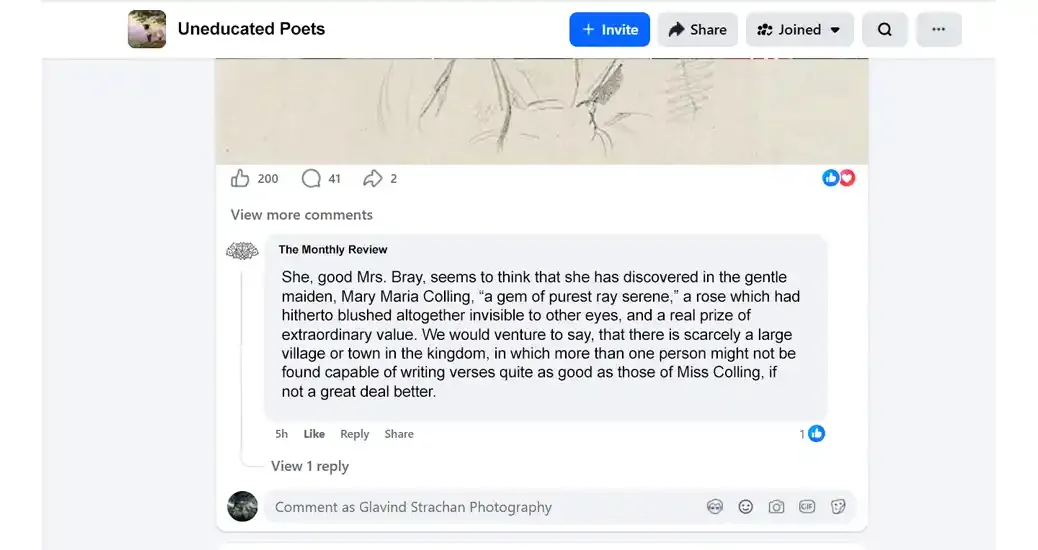
The reviews just reminded me so much of some of the tittle tattle you read online today 🤣
“Mrs. Bray’s work has died before her. One of the minor celebrities of a former day, her tales are no longer read, and her very name is probably unknown to most of the novel-readers of the present ; but she only died last year, and now we have an autobiography of her, which contains some letters of Southey’s, and occasionally interesting illustrations of social characteristics of the early part of the century; but has otherwise little that is of value.”
Further Reading on Mary Maria Colling
Primary sources
Bray, Anna Eliza, ed.Fables and Other Pieces in Verse, by Mary Maria Colling. With some Account of the Author, in Letters to Robert Southey, Esq., Poet Laureate, &c. London: Longman, 1831. Available on Google Books: https://books.google.com/books?id=xUleeaTAGzwC
The Athenaeum, no. 211 (12 November 1831), p. 762. Review of Colling's Fables, almost certainly by Maria Jane Jewsbury. https://books.google.com/books?id=XdmrNMZ3luIC&pg=PA762
The Gentleman's Magazine, and Historical Chronicle, December 1831, p. 534. Review of Colling's Fables. https://books.google.com/books?id=V6VJAAAAYAAJ&pg=PA534
The Spectator, 14 January 1832, p. 18. "Mary Colling's Poetry." https://archive.spectator.co.uk/article/14th-january-1832/18/mary-collings-poetry
Southey, Robert. "Poetry by Mary Colling." Quarterly Review, vol. 47 (1832), pp. 80–103. Published anonymously. https://books.google.com/books?id=RTi1inKch_0C&pg=PA80
Dowden, Edward, ed.The Correspondence of Robert Southey with Caroline Bowles. Dublin: Hodges, Figgis, and Co., 1881. Available on the Internet Archive: https://archive.org/details/correspondencewi00soutuoft
National Archives. Will of Mary Maria Colling, Spinster of Tavistock, Devon. Proved 13 September 1853, Prerogative Court of Canterbury. https://discovery.nationalarchives.gov.uk/details/r/D13713
The New Bray Archive, West Sussex Record Office, Chichester. The 1825 fair-copy manuscript notebook of Mary Maria Colling. Catalogue reference per Obey 2010: Box 3, Bundle 13. https://www.westsussex.gov.uk/leisure-recreation-and-community/history-and-heritage/west-sussex-record-office/
Secondary sources
Alford, D. P. Letter on Mary Maria Colling, in W. H. Kearley Wright, ed., West-Country Poets: Their Lives and Works (London: Elliot Stock, 1896). The most extensive 19th-century biographical source. Available on the Internet Archive: https://archive.org/details/westcountrypoets00wrigrich
Oxford Dictionary of National Biography, "Colling, Mary Maria (1804–1853), poet and domestic servant." Online edition, Oxford University Press, 2004. (Subscription, Wikipedia Library access, or UK public library membership required.) https://www.oxforddnb.com/view/10.1093/ref:odnb/9780198614128.001.0001/odnb-9780198614128-e-61556
Obey, Erica. "'The Poor Girl's Talent': Romantic Mentorship and Mary Colling's Fables." Keats-Shelley Journal, vol. 59 (2010), pp. 65–77. The most substantial modern scholarly treatment. https://www.jstor.org/stable/41409531
Low, Dennis.The Literary Protégées of the Lake Poets. Aldershot: Ashgate, 2006. Chapter 1, pp. 21–23, on Colling. Now published by Routledge: https://www.routledge.com/The-Literary-Protegees-of-the-Lake-Poets/Low/p/book/9780367882457
Low, Dennis.Four Literary Protégées of the Lake Poets. PhD thesis, University of Hull, 2003. The earlier version of the above. https://hydra.hull.ac.uk/resources/hull:5708
Orlando Project. Entry on Mary Maria Colling. Cambridge: Cambridge University Press. https://orlando.cambridge.org/people/1602e35e-d158-4021-9a4f-ed09808c7828 (subscription required for full entry)
Sampson, Julie. "Talking about Tavistock: Mary Maria Colling; A C19 Maid-Servant Poet." Women Writing on the Devon Land blog, 9 April 2019. Useful local-historical context. https://newdevonbookfindsaway.blogspot.com/2019/04/talking-about-tavistock-mary-maria.html
Pulsford, Ann. "A Literary Christmas 1836 at Tavistock Vicarage." Formerly on dartmoorlinks.co.uk; the original page is now offline but accessible through WayBack Machine. Cited in Sampson 2019 above for the claim that Mary Colling's headstone now stands in the churchyard in front of St Eustachius Church, Tavistock, but does not mark her original grave. This is an incorrect attribution. The Pulsford article says Mary’s grandmother’s headstone is now at St Eustachius Church. I have been unable to locate either a plot location or headstone for Mary.
Tavistock Local History Society. Thanks to the lovely people at Tavistock Local History Society, 2021. TLHS, Tavistock Cemetery Transcriptions at https://www.tavistockhistory.co.uk/
Related works on labouring-class poets in the period
Fulford, Tim, ed. Robert Southey: Lives of Labouring-Class Poets. London: Routledge, 2024. https://www.routledge.com/Robert-Southey-Lives-of-Labouring-Class-Poets/Fulford/p/book/9781032450872
Christmas, William J.The Lab'ring Muses: Work, Writing, and the Social Order in English Plebeian Poetry, 1730–1830. Newark: University of Delaware Press, 2001.
Goodridge, John, et al.A Database of British and Irish Labouring-Class Poets and Poetry, 1700–1900. https://www.exeter.ac.uk/research/projects/labouringclasswriters/
“Mr. Southey spoke warmly in praise of Mary Colling ; and observed that in the eyes, forehead, and upper part of the face she was perfectly beautiful. “ What a sweet creature she would have made,” said he, “had she but been brought up in a little higher sphere of life.””
For Clarity - A Footnote
I have no experience in analysing poetry, nor even researching local history.
I will not defend my claims, they are just claims, idle thoughts that occurred to me and rather than let them dissipate into the ether, I decided to write them down - my sincere hope is they ignite an interest in maybe one other person or at least my methods (mad as they be) can be expanded upon by people who actually know what they are doing.
If anything I have said upsets you, I am truly sorry and I meant no harm, I’m just curious.
My references are incomplete as in the construction of this piece the task became rather unwieldy and I lost my focus for a while (I shall attempt to update as many as I can).
That being said, I have saved as much of my source material (even if it’s a url and nothing else) to a folder on my backup hard drive and am happy to share these with anybody with a similar inquisitive mind 🤣
More about this in my article “Method in the Madness (Method TBC)”