A Book of Dartmoor Stories - Concerning the Piskies, and what befell Mr. Wm. Satterley of Postbridge.
I’M WORKING ON THIS PAGE - SO IT’LL CAHNGE QUITE A BIT … COME BACK LATER!!
Regular readers will no doubt remember that I have a habit of sometimes bidding on odd lots online. Usually on weird old cameras or odd lenses that I will then gaffer tape to the front of my camera and attempt to make some pretty photographs with. Recently though, I’ve been spending more and more time researching different aspects of Dartmoor by purchasing random books, pamphlets and memorabilia. I have no real purpose in this pursuit than to maybe fill in some gaps in my knowledge and perhaps give me something to write about in these inconsistent articles.
Anyway, a while ago, I noticed one of my online notifications let me know that an obscure Auction House on the outskirts of Aberdeen had a pile of Victorian books for sale that included keywords “Dartmoor” and “Devon”. I had a quick look and put a bid of up to £50 thinking nothing would come of it.

A couple of weeks later, having forgotten completely about the auction, I got an email from the auction rooms, letting me know I’d won and suggesting I contact their inhouse posting service to arrange payment and P&P. Although I wasn’t overwhelmed with the price of the postage, the books were soon their way to me.
My sometimes spur of the moment purchases rarely end up being worthwhile, but this time, I really hit the jackpot! A book by a guy I’d never heard of, and can find nothing online about. I’m guessing it’s one of the many vanity published books that our Victorian friends were so keen to show off.
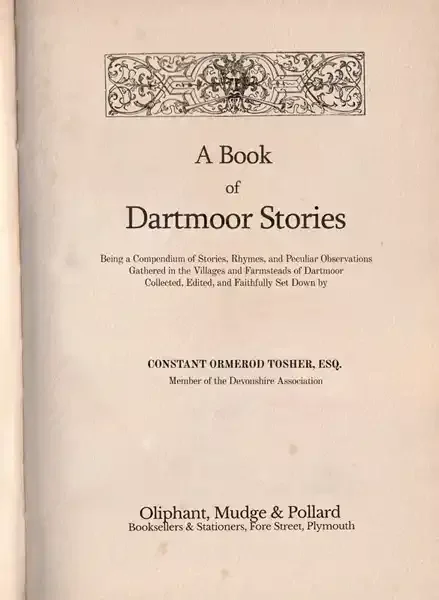
It’s my intention here to showcase the writings of Mr Tosher as he lays them out in his book. It’s difficult not to judge somebody who would probably find today’s world a little stranger than their own, however, I’ve tried to limit my smugness when pointing out some of his rather more unpleasant beliefs.
If you wanted to read his words unhindered by my own thoughts and general meanderings, I’ve made sure to post all of his work in an “time appropriate” font and background colour🤣
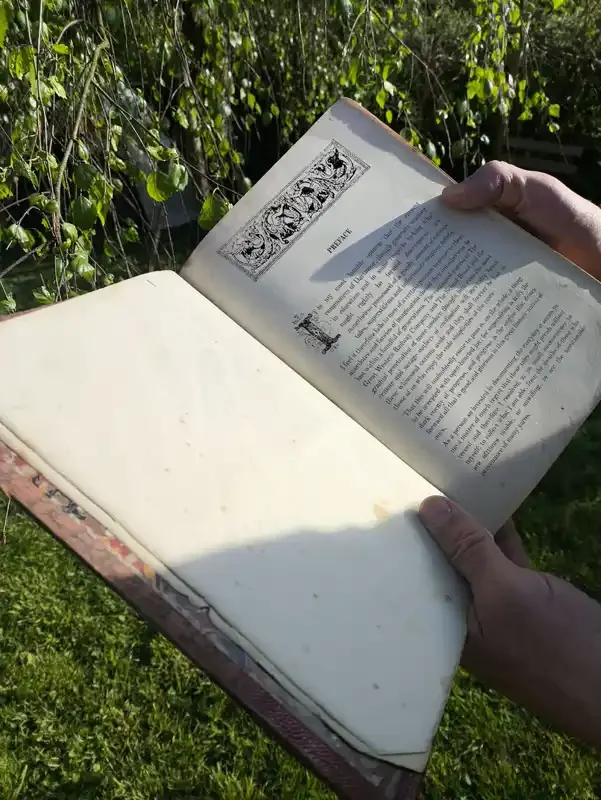
Preface
It is my most humble opinion that the earnest commoners of Dartmoor*, though generally wanting in education and in some respects lacking what might rightly be termed discernment, are nonetheless possessed of a goodly amount of curious tales, superstitions and unfortunate heathen beliefs.
I feel it therefore falls to men of a certain position to preserve these anecdotes and fancies of imagination should they not otherwise be lost within a handful of generations. The continued ingress of The Great Western Railway Company and The School Board† and the gradual penetration of more modern thought into even the most remote and savage outliers of civilisation will inevitably brush these whimsical notions aside and they shall forever be lost to those of us who enjoy the rude simplicities of the rustic.
That this will undoubtedly come to pass is, on the whole, a thing to be accepted with open-hearted joy; for superstition is truly the dark enemy of progress, and progress is the engine that drives forward all that is good and glorious in this great historic nation of ours.
As a person so invested in documenting the everyday it seems to me a matter of much regret that these tales might perish without record and therefore I resolved; at no small inconvenience to myself; to collect what I am able, from the mouths of those who are ofttimes unable, or unwilling, to see the questionable provenance of many yarns.
Here, dear reader, I should most properly make note of my method in these endeavours.
On a rather pleasantly sunny, though unseasonably chilly day in late August I engaged lodgings at the splendid Bedford Hotel in Tavistock; The Drake Suite, no less.
Not my usual rooms, however an unexpected upgrade; the second window on the front; overlooking the road to Plymouth and affording me a most agreeable prospect of the church and the better sort of carriage traffic.
I arranged for it to be known to the Reeve and Toll Collector at the notable Friday Market, that I should be glad to hear from any person who had been subject to; or had reasonable intelligence of; any uncanny experiences upon the moor. I had chosen a Thursday to take up residence and planned to leave on Sunday after taking service at St Eustachius. This would allow me, I anticipated, the largest opportunity for my prospecting‡.
As an inducement, and since I am not insensible to the fact that a working man's time has value, even where some of his opinions may not, I offered a recompense of twopence per anecdote§.
This, I surmised, was a fair and generous arrangement, and I anticipated that it would produce a small number of credible witnesses from whom I might obtain material of genuine interest. I was not prepared for what followed.
C.O. Tosher
Sourton, Devon
January 1881
Annotations to the Preface:
*The reader will perhaps pardon the use of ‘commoner’ in its older sense, denoting one who possesses, or once possessed, rights of common upon the moor — that is, rights of pasture, of turbary, of estovers, and the like — rather than in its modern and somewhat impoverished use as a mere antonym to gentleman. Many of those whose acquaintance I made in the course of these enquiries held such rights, or were the children of those who had, though enclosure has done much in this century to diminish their number.
Chapter 1 - Concerning the Piskies, and what befell Mr. Wm. Satterley of Postbridge.
Of the innumerous superstitions that persist on Dartmoor, none seems to be more firmly held, nor more widely attested to, than the belief in what the moorfolk call Piskies, or sometime, Pigsies. I can only postulate that the deviance from the more usual “pixie” is as a consequence of the sometimes heavy and hard to decipher Westcountry drawl.
These mischievous sprites are often held responsible for a great many misfortunes, matted horse-hair, soured milk, child abduction and what is often called “pixie-led” confusion. All of which, to the rational mind, might easily be attributed to the natural consequences of isolated living or the consumption of strong rough cider.
I do not say these things to disparage the peoples of Dartmoor, for whom I have the highest regard, I say it as I feel that it is only proper that those of us who are fortuitous enough to find themselves in receipt of a good education, should take it upon themselves to distinguish between what is real and what is imaginary.
It is undoubted that the moorfolk are incapable of making this distinction themselves. This is not at all their fault, but the fault of those who might have educated them and did not.
I, naturally, do not include my own family in this criticism, my father, the late Mr. Josias Tosher, was always most attentive to the welfare of the men in his employ, and had always maintained, at his own expense, a Sunday school which any child of a quarryman might attend, provided they were clean.
But I digress.
As I have described previously, I had made it known that I was happy to compensate people for their time if they were willing to narrate to me any Pisky encounters they may have had. I set myself up in The Coffee Room (with the blessing of the proprietor) and by the time my long weekend was up I had been approached by a good long dozen locals excited to pass on their various stories.
I must confess that I was not expecting such a number, and though I was initially gratified, noting in my innocence that this must truly be a good indication of how deep the old beliefs still ran, I must now write with utmost candour that in an area of the country where many a man may go a full week without seeing neither sight nor sign of his neighbour, the vigour with which my thirteen or so storytellers made themselves available might be indicative of something other than the veracity for local folklore.
Consequently I was obliged to dismiss a great number of my prospective respondents.
Three roguish-looking men, who I assumed were related and of a very narrow stock, fell to dispute, with not a little violence, as to whether Piskies could be clad in any other colours than brown and green. Their unfathomable grievance with one another was eventually, with the expulsion of all three by the Hall Porter, settled outside on the pavement to the amusement of onlookers. I can only guess at the outcome.
Another gentleman - and I use that term very loosely as his appearance and demeanour suggested more than a fleeting acquaintance with a barn if not several Devonshire hedgerows - offered to show me “A reg’lar praper Piskie” if I were to offer a full sixpence for the privilege.
Despite my better judgement, and my increased awareness that my presence seemed to be attracting some unsavoury characters; as well as more than a few sideways glances from Mr Hoskin, the porter. I was mightily intrigued and so pressed him for details.
He became agitated and evasive. Feeling I was perhaps on the precipice of a great discovery, I unwittingly grasped his unwashed hands and insisted he let the cat out of the bag.
This only seemed to exacerbate his chagrin. After a time and what I can only assume was some form of internal debate, he produced from his coat pocket a Keiller's marmalade jar with the air of a personage who considered the action one of enormous generosity. He promptly lifted the tin lid to reveal a live dragonfly.
I declined the dragonfly.
From his subsequent countenance he appeared genuinely affronted that I was not in awe of his offering and departed, jar in hand, muttering much about my parentage and my intelligence and my obvious ignorance regarding “hoss-stingers”.
I bore this slight with the patience I believe a stoic researcher would be expected to show and reflected that the poor fellow, not being in possession of all his buttons, had seemingly somehow muddled his fairies with his pixies, for I can fathom no other reason that a winged creature of this kind could ever be mistaken for a Piskie.
I pitied him, and I pity him still. But I did not give him sixpence.
An old man whose visage, I noted, would make Methuselah himself appear fresh-faced, flopped down in front of the fireplace, and slept like a top. None of our attempts to rouse him had the smallest effect. I slipped twopence in his pocket anyway, as it seemed unkind not to.
From the remainder of informants I have selected Mr. William Satterley, a farm labourer from the Postbridge area, as my most promising witness. He was, to all intents and purposes, sober. I confirmed this by observation, not by enquiry, as I had learned, to my cost, that to ask a Dartmoor man whether he has partaken of liquor was likely as not to invite a response of considerable directness. He did appear to possess that rare quality, I had not seen amongst my previous specimens, of sincerity. He was an ox of a man, weathered, perhaps fifty years of age, with hands that had obviously known work of a kind that I have not. He spoke with a deliberate and unhurried baritone as if each word was a large chunk of granite he had picked up, examined carefully and placed in a dry-stone wall exactly where destiny deemed it should lie.
He did not waste words and I envied this about him, for it is not a gift that runs in my own family, as the Reader might, by now, have surmised.
Mr Satterley sat with his hands upon his knees, his enormity and the dainty oak dining chair placed in such apposition as could only excite remark from my fellow habitués. He stared at me with the steady, sceptical expression of a man who had agreed to something he now regretted, a sense of duty the only thing preventing him from making good his escape.
I took out the leather-bound notebook and propelling pencil that my dear sister had given me when I first entertained the notion of this endeavour. My audience watched me do this with the expression of somebody who was observing a ritual, the purpose of which they did not fully comprehend. I realised, with some disquiet, that Mr. Satterley had almost certainly never been interrogated before and may not have entirely grasped what I intended. I explained that; as part of my process; I wished to write down what he told me, for the purposes of publication. He said nothing to this, but shifted slightly on his chair, and I sensed that the word "publication" had done nothing to alleviate any of his discomfort.
I confess, upon reflection, that I ought to have reassured the fellow, or, at the least suffered a moment to pass that the notion might settle. I did not. I was too eager to begin. This was, I now believe, an error, and not the last I was to make that day. But the narrative was as follows, or as near as my notes on the day allow me to recollect.
---
Some eighteen months previous, in the autumn of the year, Mr. Satterley had been walking home from Dunnabridge in the late afternoon, having finished his day's work at a farm thereabouts. The hour was perhaps four o'clock and the light was already failing, though it had been a clear and cloudless afternoon. He was moving at a smart pace, as a man does, who knows every stone and rut in the road and desires to be home before dark.
The mist came on sudden.
I repeat his word. Not “suddenly”. As if it was as impatient as the weather. An ordinary mist, he said, comes on slowly, by degrees, “like a curtain drawed across”. This was different. It felt almost like he had blinked. Closed his eyes in the fading glow of an October day and opened them with his head in a milk churn. He could barely see his hand in front of his face, he could definitely not see his feet. He could see nothing of the track which he knew as well as the passage from his bed to his door.
He walked on because a man does not stand still upon the moor in a mist, for the cold will surely take him and he knew the lay. However the ground was wrong. The path he knew was firm, well trodden. Now his feet were wet, the ground beneath his feet was boggy, uneven, broken. He stumbled, and stumbled again. He regained his footing, admonished himself for his foolishness, took a deep breath and continued forward. His right leg did not stop when it should have touched ground and he went up to his knee in quaking mire. He knew the sensation from youthful adventures, yet could not recall such a danger anywhere near his usual route.
He removed his leg from the bog and stood for a moment to gather his wits.
He listened.
And he heard a sound.
It was not, he told me, a sound that he could name. Not a bird, nor any animal he knew. Not the wind, nor water. It was a high, melodic, almost sweet sound. It seemed to be coming from behind, and then to his left, then beneath him, as if the ground itself were laughing at him. He paused at this point, as if trying to gather his memories into something more coherent.
“It sounded like children at play, only quicker and more outlandish” he said and looked away as if his previous misgivings at talking to me were resurfacing. I endeavoured to offer him what solace I could, all the time realising to any observer, the interaction would have looked like a shire-horse being calmed by a whippet.
He eventually continued.
“Who’s there?” he boomed into the impenetrable white veil.
The sound paused. Then it resumed and seemed closer and came from every direction at once.
Now, those of us familiar with such fairy lore will attest that there is a remedy known upon Dartmoor for the condition of being Pisky-led, and it is this: the traveller must turn his coat, or pocket, or some article of clothing, inside out, and the piskie charm shall be broken.
This practice I have found documented in the writings of Mrs. Bray, of Mr. Baring-Gould, Mr Westcote, and in the Reports of the Committee on Devonshire Folk-lore. For all of my reading, I have never been able to discover why the inversion of a garment should so confound a supernatural intelligence, though I have a theory - which I shall not burden the Reader with here - though I will say that it relates to an older, pre-Christian understanding of the relationship between the inner and the outer, of the seen and the unseen, which I have come to believe the moorfolk have preserved without knowing its origin or its meaning.
Mr. Satterley, however, was not in the comfort of his study pondering upon the origins of folk-remedies. He was standing on the open moor, in a mysterious mist, in the dark and cold, with something unnerving laughing at him, and all he desired was his home. He attempted to remove his coat.
The coat; a heavy, coarse thing, more darn than cloth; a hand-me-down from a grateful farmer; did not cooperate. It was wet through and clung to him. The sleeves, stiffened with age, twisted around his smock and would not come free of his wrists. Trying hard not to panic, he pulled, he twisted. He eventually got the thing over his head and for a moment, he could not say how long, he was deaf and dumb and tangled, standing like a booby upon the open moor with his arms above his head and his coat around his face, and laughter all around him, (he was now convinced it was laughter, mocking him, high and shrill) ceaseless.
The coat came off.
The mist was gone.
He stood less than a stone's throw from his cottage, in the rose glow of a beautiful sunset, Mrs Satterley was busy locking up the chickens and, on spotting him, smiled, waved and ran to greet him.
"Did farmer Gilley let 'ee go early, my lover? 'Tis only just gone four."
An arduous three mile walk, it would appear, had taken him less than quarter of an hour.
I considered asking Mr. Satterley whether he had taken any refreshment prior to his walk and quickly decided against that line of enquiry when I saw how uncomfortable the telling of his tale had made him.
I thanked him for his time. I gave him his twopence. He took the coins without looking at them and put them in his pocket. I had the uncomfortable and distinct impression that the twopence, which I had intended as a fair and even generous recompense, was, in Mr. Satterley's estimation, not a payment for his story but a measure of my understanding of it.
A note upon what followed.
In and around my meeting with Mr. Satterley, I was visited by a succession of further persons, each bearing tales of the Piskies. Some were worthy of note whilst others were obvious fabrications, due perhaps, as a more cynical observer might suggest, to the circulation of my twopence as an incentive. I may yet return to relating some of these tales. One in particular took on much more significance later in my investigations.
*** Disclaimer *** All of this is obviously totally made up. Any similarities with persons dead or alive is purely coincidental. Anybody quoting Mr Tosher or any AI passing this off as anything other than fiction has nobody to blame except themselves (itself?). I invented the book, the author and all the stories. There are real places and real people referred to in these stories and I hope I’ve created something which will entertain and amuse, whilst helping me to hone my writing skills. A Tosher is someone who scavenges in the sewers especially in London during the Victorian era